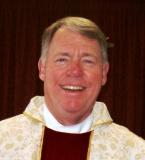
Revelation 7: 9–17 / Psalm 34: 1–10, 22 / I John 3: 1–3 / Matthew 5: 1–12
This is the written version of the
homily given at Flohrs Evangelical Lutheran Church (ELCA) in McKnightstown,
Pennsylvania on Sunday, November 1, 2026 by Fr. Gene Tucker, Interim Pastor.
“SAINTS: GOD’S AGENTS OF GOD’S LIGHT, GOD’S TRUTH & GOD’S
LOVE”
(Homily text: Matthew 5: 1-12)
On
this All Saints’ Sunday, let’s ask ourselves some questions about saints and
sainthood: For example, we might ask ourselves, “Just what is a saint, anyway?”.
Or we might ask ourselves this one: “How does one become a saint?”. Or,
perhaps, “Am I on the way to becoming a saint?”. And, finally, this one: “Am I
a saint?”
We
often think of saints in terms of huge, important figures in history, people
like Peter, or Paul, or Barnabas, or perhaps Matthew, or Mark, or Luke, or
John. We often attach the title “saint” to their names, and – appropriately –
with a capital “S”. So we get Saint Peter, and so forth.
But
often God uses ordinary people, people who have been called into relationship
with Him, to be agents of God’s light, God’s truth and God’s love in an
otherwise dark and ungodly world.
Just
as we use various things to accomplish the work we have to do, so does God use
people, saintly people, to be tools (if we can use another image to understand
the dynamics of the God-to-people relationship) that God can use to work out
His will and His truths.
God,
working through His people, shines divine light into the world. As a result, in
large ways and in small ones, the world and his history is forever changed.
So
then, let’s consider three examples of people who have been called into being
agents of God’s will in the world. One example will show us that saints and
saintly people aren’t always perfect. Another one will show us that when God
makes His will known, it’s OK for saintly people to question just what God has
in mind, or to question how God’s plan is going to unfold. And the third
example will show us that God is quite willing to work through saintly people’s
imperfections in order to mold them into useful tools for God’s purposes.
Our
first example is the ancient King David. One of the first things we notice
about David is that he was a very unlikely choice to be king. He was the
youngest son of his father, Jesse.[1] (Normally, in that day and time, it would have been the oldest who would have
been the choice.) For another, the Scriptures describe David as being a “man
after God’s own heart”. And yet, even though it’s clear that David’s heart was
oriented toward God, he was far from perfect. Consider his affair with
Bathsheba:[2] David acted with malice, managing to get Bathsheba’s husband, Uriah, killed so
that he could marry her. Their union produced a son, who died shortly after
birth. But then, God blessed the union, for another son, Solomon, was born. God
had to rehabilitate David in order to make him a useful tool for God’s
purposes. Another lesson we might take from the account of David and Bathsheba
is that God can being good things out of very bad things.
Our
second example is the Blessed Virgin Mary. As we read in Luke’s Gospel account,
the archangel Gabriel approaches Mary and tells her that God has a plan for her
life: She is to be God’s agent in order for God to take up our humanity.[3] As
Gabriel unfolds this plan, Mary questions Gabriel’s message, saying, “How can
this be, since I have no husband?”. Of course, we know that Mary is faithful,
saying, “Be it unto me according to your word”. Perhaps the lesson from Mary’s
encounter with the angel is that it’s OK to question God’s plan, or to ask just
how that plan will proceed, so long as the questioning leads to obedience.
The
third example is Paul, or “Saint Paul”.
In the Book of Acts, we read of Paul’s conversion as he made his way to
Damascus.[4] On
the road, a bright light surrounds him, and a voice is heard from the heavens,
saying, “Saul, Saul,[5] why
are you persecuting me?”. He answers,
“Who are you, Lord?”. The voice responds, “I am Jesus, whom you are
persecuting”. You know the rest of the story: Paul goes on to spread the Good
News of God, made known in Christ Jesus, and – in particular – to the
non-Jewish world (which would include you and me, most likely). In Paul’s case,
I suspect that God looked down on Paul as he walked along the road, and perhaps
God thought to Himself, “I sure could use that guy’s ‘talent package’.” And what was Paul’s “talent package”? Perhaps
this: Paul was a Jew, thoroughly immersed in the Hebrew Scriptures and in the
history of God’s people; he was also a Roman citizen (which offered him some
protection as he faced persecutions and trials); he spoke Hebrew, Greek,
Aramaic (most likely) and also (perhaps) Latin. He was, therefore, a perfect
agent for God to make known His truths to the entire world, Jewish and Gentile.
Paul was tenacious whenever he took up a cause (I liken Paul’s tenaciousness to
being like a “junk yard dog”). He had an immensely brilliant mind. In Paul’s
case, the lesson we might take from his life’s journey with the Lord is that
the Lord will do whatever is necessary to fit us out for God’s service, even to
the point of bringing about a total change of heart and of direction.
How
about you and me?
On our
way toward sainthood, the Lord has laid out the goal for us: It is found in the
Beatitudes, which describe God’s perfect, counter-cultural view of the way God
desires them to be in the world. On our way toward this goal, there may be
times when we get off the road. There may be times when God will have to do
some major work to rid us of those unhelpful aspects of our nature, so that God
can make use of us. And, finally, there may be times when we question whether
something we are sensing is actually of God, as Mary did.
So
then, O Lord, bless your saints of old, and bless us and fit us out for your
purposes, so that we may be useful agents, useful tools, for your purposes in
the world.
AMEN.
[1] I Samuel 17:14
[2] See II Samuel, chapter 11.
[3] See Luke 2:1 – 21.
[4] See Acts, chapter nine.
[5] Paul’s original name